

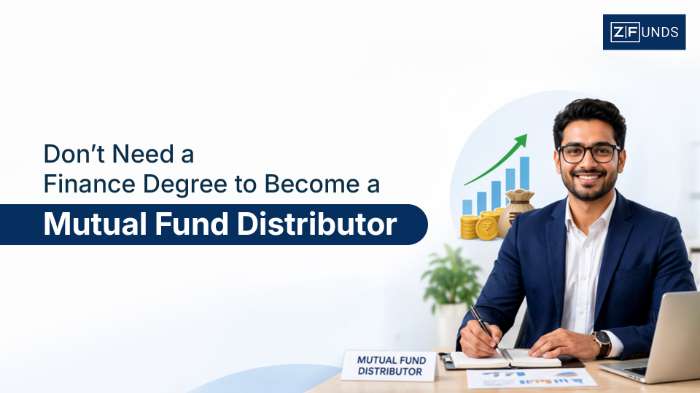
Don’t Need a Finance Degree to Become a Mutual Fund Distributor
Many people assume that entering the financial services industry requires a financial degree, but the fact is, you don’t need an MBA in Finance, a CA or a CFA. You don’t even need a B.Com degree.
What you do need is a simple mindset shift: mutual fund distribution is less about “finance expertise” and more about process, communication, and trust.
In India, anyone 18+ years old who clears the NISM VA exam and gets an AMFI ARN can become a mutual fund distributor—regardless of background. This makes it an accessible opportunity for teachers, sales professionals, insurance agents, homemakers, and anyone from a non-finance background who has ever wondered, “Can I really start a mutual fund distributor business without a finance degree?” This article explains why a financial degree matters far less than communication skills and trust when it comes to building a successful career as a mutual fund distributor.
Start Your MF Distributor Business at ZERO Cost!
By clicking on button you agree with and

Get Updates on WhatsApp and SMS
What Exactly Does a Mutual Fund Distributor Do?
Before we debunk the “finance degree myth”, let’s be clear about the real job of a mutual fund distributor (MFD).
Your core responsibilities are:
- Explaining how mutual funds work in simple language (SIPs, SIP vs lump‑sum, equity vs debt, etc.).
- Helping investors choose suitable funds based on time horizon, risk, and goals.
- Handling KYC, onboarding, and documentation (e‑KYC, ARN capture, EUIN, etc.).
- Running portfolio reviews and nudging clients to stay invested.
- Providing a human layer between investors and AMCs—answering queries, calming nerves in market falls, and guiding long‑term discipline.
You are not:
- A fund manager deciding which stock to buy,
- A trader predicting market tops and bottoms,
- An analyst is reading the balance sheets of 100 companies.
That work is done by fund managers and research teams. Your job is to help people invest correctly and stay invested.
You Don’t Need a Formal Finance Degree—Here’s Why
1. Regulatory path is clear (and not degree‑based)
To become a mutual fund distributor, SEBI and AMFI don’t ask for:
- B.Com,
- MBA,
- CA / CFA / CFP.
All they require is:
- Age 18+,
- Passing NISM Series V‑A (Mutual Fund Distributors Certification),
- Registering with AMFI to get an ARN (AMFI Registration Number),
- Doing your own KYC and setting up basic operational infrastructure (bank account, GST, etc.).
If you clear the exam and follow the process, you can legally distribute mutual funds—even if your degree is in Arts, Commerce, Engineering, or even no formal degree at all.
2. Most successful distributors are “learners,” not professors
Real‑world success stories show that top‑earning mutual fund distributors come from:
- Insurance and agency channels,
- Sales, banking, and retail,
- Teaching, admin roles, and even home‑based businesses.
What they share is:
- Strong sales and communication skills,
- Ability to build trust and long‑term relationships,
- Willingness to learn on the job (NISM, updates, product changes, and taxation).
A finance degree might give you some jargon, but it doesn’t automatically teach how to handle a client’s panic during a market crash that comes from experience, empathy, and structured learning, not your degree certificate.
3. What really matters more than “finance” knowledge
If not a finance degree, what actually makes a distributor successful?
| Skill / Trait | Why it matters more than formal finance education |
| Clear communication | Explaining SIPs, risk, and taxation in simple Hindi/English is more valuable than quoting textbook formulas. |
| Curiosity & continuous learning | Staying updated on NISM changes, AMC updates, and tax rules is what keeps you relevant. |
| Sales & follow‑up ability | Turning warm leads into SIPs month after month is what drives your AUM growth. |
| Tech‑savviness | Using MFD platforms, apps, and online KYC tools is now basic hygiene. |
| Emotional intelligence | Holding a client’s hand in a 15–20% market fall is what builds trust. |
For clients, it doesn’t matter if you studied finance; they care that you speak clearly, follow KYC correctly, and stay in touch.
Real‑Life Examples: People Who Went From “No Finance Background” to MFD Success
While we can’t list every name, there are several visible patterns:
- Ex‑insurance agents who switched to MFDs and scaled AUM by using their existing client base and relationship‑management skills.
- Teachers and government employees who started part‑time, took NISM‑V‑A, and slowly built SIP‑based portfolios.
- Sales professionals who translated field‑sales skills into financial advisory, asking better questions, understanding client needs, and offering structured SIP plans.
In many cases, their “finance learning” started after they became distributors, not before.
They used:
- NISM‑V‑A as a structured foundation,
- MFD‑training webinars,
- Internal notes from their empanelled distributor platforms.
Even Rohan, a mutual fund distributor featured in industry write‑ups, didn’t start as a finance expert; he grew by learning on the job and educating clients patiently, not because he had a fancy degree.
The Only “Finance” Knowledge You Actually Need
You don’t need an MBA, but you do need to understand a few practical concepts:
- Basics of mutual funds: SIP vs lump‑sum, equity vs debt, ELSS, index funds, etc.
- KYC, ARN, and EUIN: How to onboard correctly so every transaction is compliant.
- Risk profiling: Asking about time horizon, risk tolerance, and goals before suggesting a fund.
- Taxation: How equity and debt funds are taxed, and the role of indexation and holding period.
- Common pitfalls: Over‑concentration in one sector, ignoring diversification, and chasing “top‑performing” schemes only.
The NISM‑V‑A exam and basic MFD‑training modules are designed to teach exactly these concepts in a structured, exam‑oriented way.
If you can:
- Read the NISM‑V‑A module carefully,
- Take 1–2 NISM VA mock tests,
- Watch a few Hindi/English explanation videos,
Now, you can comfortably launch your career as a mutual fund distributor without a finance degree.
MFD vs Investment Advisor: Where Does “Finance” Actually Matter?
It’s important to distinguish:
- Mutual Fund Distributor (ARN holder): Facilitates mutual fund transactions, explains products, and earns mutual fund distrtributor commission. Formal requirement = NISM‑V‑A.
- Investment Advisor (SEBI‑registered IA): Gives deeper, fee‑based advice, often needs more advanced certifications (e.g., NISM‑X‑A, X‑B or higher).
For most people starting in distribution, the MFD route is enough, and it’s deliberately designed to be accessible to non‑finance backgrounds.
Finance degrees can be useful if you later want to:
- Become a full‑time investment advisor,
- Run a large wealth‑management firm,
- Work with high‑net‑worth clients on complex portfolios.
But for starting as a mutual fund distributor, the barrier is process + certification + attitude, not academic background.
How You Can Start—Even If You’re Not From Finance
If you’re ready to move from “Can I?” to “How?”:
- Check your eligibility:
- 18+ years old,
- No criminal record,
- Basic clarity to learn and follow processes.
- Register for NISM‑V‑A and clear the certification.
- Apply for AMFI ARN and get your mutual fund distributor licence.
- Join at least one MFD platform (or empanel with a few AMCs) for:
- Lead‑generation support,
- Knowledge‑base,
- Tools and dashboards.
- Start small:
- Explain SIPs to family and friends.
- Convert 5–10 people into systematic investors.
- Scale from there.
Final Thought: It’s About Learning, Not Lineage
A finance degree might help you sound like an expert faster.
But long‑term success as a mutual fund distributor depends on:
- How well you communicate with clients,
- How consistently you follow the process,
- How patiently you build trust.
If you’re willing to learn NISM‑V‑A contents, stay updated, and put your clients first, you absolutely don’t need a finance degree to be a successful mutual fund distributor.
For many, starting as an MFD is the best entry point into finance, because you learn by doing, not just by reading textbooks.