

Beyond Fund Distribution: Value-Added Services That Define the Modern Mutual Fund Distributor
Updated on March 9, 2026
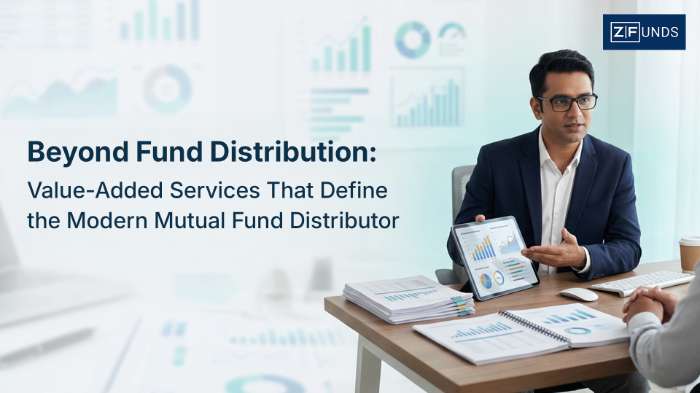
The financial industry in India has undergone tremendous change in the last decade. With the rise in financial literacy, easy access to online investment tools, and the increasing number of financial products, the expectations from financial services have changed dramatically. Investors no longer expect just product recommendations from financial services. Instead, they want guidance, clarity, and a partnership for their long-term financial goals.
In this dynamic financial environment, the role of a Mutual Fund Distributor (MFD) has undergone significant change. Traditionally, the role of a mutual fund distributor was to act as a liaison between the investor and the Asset Management Companies (AMCs) and to provide operational support during the transaction process.
However, the expectations from mutual fund distributors have changed dramatically in the last few years. Investors want more from their financial partners. Instead of just transaction-based services, they want to engage with financial services that help them make better financial decisions, organise their finances, and stay disciplined in their financial goals.
This has opened doors for mutual fund distributors to move from product-selling companies to value-added services companies. This article will discuss the various value-added services for mutual fund distributors to move from product-selling companies to trusted financial partners.
Start Your Own Business at ZERO Cost!
By clicking on button you agree with and

Get Updates on WhatsApp and SMS
The Changing Expectations of Investors
The modern-day investors are the best-informed investors in history. The availability of financial education through digital media, blogs, and social media has enabled investors to become aware of different investment strategies and products. In addition to this, the increasing number of online investment sites has made it easier for investors to invest in the market.
However, investors are increasingly looking for personalised attention and strategic advice from financial advisors. Investors are no longer asking questions like “What kind of mutual fund should I invest in?” but are asking questions like:
- How can I effectively manage my debt and invest?
- How can I minimise my tax liability and invest?
- Should I invest internationally?
- How can I effectively take care of my family in terms of wealth management?
These questions indicate that investors are looking for complete financial support rather than mere advice.
Mutual Fund Distributors who are willing to adjust to these changes and offer effective support to investors can develop stronger and longer-lasting relationships with investors.
Key Value-Added Services Mutual Fund Distributors Can Offer
1. Debt Management Guidance
One of the biggest roadblocks that people face in investing is unmanaged debt. Many of the clients face situations where they have to manage multiple financial obligations, such as personal loans, credit card dues, and consumer financing.
The role of a mutual fund distributor in such cases can be significant in helping the clients manage their debts.
The first step in this regard is to create financial clarity. This can be achieved by asking clients to list their outstanding debts, including interest rates, EMIs, and tenure. Once this information is gathered, a systematic plan can be made.
For instance, clients can be advised to clear high-interest debts such as credit cards and personal loans before investing in other avenues. Moreover, clients can be helped to track their expenses or maintain a separate fund for such expenses, which can go a long way in creating financial discipline.
Distributors may not be able to offer financial planning services, but these steps can go a long way in helping clients get their financial lives together. Once clients start to see improvements in their financial lives, they start to trust the distributor’s advice even more.
2. Practical Tax Awareness and Investment Efficiency
Taxation has a very important role to play in wealth creation. But it has been seen that many investors don’t take into consideration the tax implications of their investment decisions.
Small changes can make a huge impact on investment decisions. Mutual fund distributors can create value by enlightening clients on tax implications related to their investments. For example, explaining to clients the distinction between short and long capital gains or planning their investments before the financial year ends can create value for clients.
Distributors can work together with chartered accountants or tax experts to create value for clients. This will ensure that clients get accurate tax information while the distributor manages their investment relationships.
Clients value professionals who can enable them to retain more of their investment returns instead of focusing on market performance alone.
3. Facilitating Global Diversification Through Emerging Financial Hubs
As the wealth creation story is unfolding in India, investors are looking towards the diversification of their investments globally. This will provide access to global investments, which will de-risk their investments and provide access to global industries and markets.
The most important development has been the launch of the International Financial Services Centre (IFSC) by India, located at GIFT City. This is a financial centre through which Indian investors will be able to access global financial markets, and regulatory control will be maintained in India.
Investment structures have been created through which investments can be made into global assets such as global equities, offshore funds, and alternative investments. In some cases, investments can be made through the Liberalised Remittance Scheme, which allows Indian residents to invest up to $250,000 every year.
For mutual fund distributors, knowledge about these emerging trends is an important tool that will act as a differentiator. They can offer their high-net-worth and globally oriented investor clients diversified investment options.
Moreover, individual distributors may also associate themselves with asset management firms that offer global funds through IFSC platforms. Often, the distributor may be able to participate in the distribution of such products even if they are not located in the physical location of the financial hub.
This facility enables the distributor to cater to the needs of sophisticated investors who want to access global markets without exiting the Indian market.
4. Helping Clients Achieve Accredited Investor Status
The other opportunity that is likely to arise for the mutual fund distributor is helping their eligible clients become accredited investors.
The framework for the definition of accredited investors is based on the identification of individuals with high financial knowledge and those whose income levels or net assets meet the specified criteria. The accredited investors are then allowed to invest in various alternative investment funds, venture capital funds, and other private markets.
The common criteria for the definition of accredited investors include individuals whose annual income is at least $200,000 or whose net assets amount to at least $1 million, excluding their primary residence, and whose assets are invested in financial instruments.
Assisting clients in grasping these requirements enables distributors to track their financial progress, thus creating strategies to attain accreditation. This might mean increasing investment allocations, reducing liabilities, or consolidating assets into more defined portfolios.
As a result of attaining this accreditation, investors would be able to access investment opportunities that, while having greater return potential, also carry a greater level of risk.
Through this process, distributors can assist clients in a responsible manner while positioning themselves as a trusted partner in the development of sophisticated wealth management services.
5. Continuous Portfolio Engagement and Investor Education
One of the most important services that a mutual fund distributor can offer is the service of continuous engagement with the clients.
Many investors tend to lose their financial discipline during periods of market volatility. Corrections in the market, economic conditions, or negative market news may force investors to take emotional decisions, such as selling their investments or halting their systematic investments.
Engaging with the clients at regular intervals can help the investors avoid such emotional decision-making. Meetings can be conducted to discuss the performance of the portfolio, the financial goals, etc.
Apart from portfolio discussions, the distributor can also conduct investor awareness programs, which can prove to be extremely beneficial in increasing the financial literacy of the clients.
Thus, the entire relationship between the distributor and the clients changes over a period of time. Clients tend to look at the distributor as an advisory partner rather than an arranger.
6. Building Multi-Generational Financial Relationships
It is also rare for wealth creation to be a one-generational activity, and many families desire continuity in wealth management so that future generations can sustain and increase wealth.
Mutual fund distributors may create such continuity by advising clients to include their families in discussions about wealth management. Educating the next generation of clients about investment ideas such as SIPs, asset allocation, and compounding will ensure the continuation of financial literacy.
This will also create a long-term relationship for the mutual fund distributor with the client’s family.
The mutual fund distributor will eventually become a trusted guide for the client’s family, creating a long-term relationship and increasing the stability of the relationship.
The Strategic Importance of Value-Added Services
Strengthening Client Trust
Trust is the foundation of any financial relationship. Investors are likely to stay loyal to those professionals who show a genuine interest in their financial well-being, as opposed to those who are only interested in selling products.
Value-added services showcase the commitment towards the client's success and further emphasise the distributor's role as a partner.
Enhancing Client Retention
Markets are inherently volatile, and during a slump, investors are likely to question their investment strategies.
A distributor's continued communication with the client and efforts to reassure them during these times will help in retaining them. Good relationships, developed through continued engagement, will help investors stay disciplined during these periods.
Generating Referrals and Organic Growth
The best marketing tool for any financial professional is a list of satisfied clients. Clients who experience significant value as a result of the distributor’s financial guidance will be more likely to refer the distributor to their friends, family, and professional network.
Eventually, referrals will become a major contributor to the growth of the business.
Ensuring Long-Term Business Sustainability
The financial services sector is becoming more and more competitive due to the emergence of digital platforms, robo-advisory platforms, and investment platforms.
The traditional distributors of financial products face the challenge of competing with low-cost platforms; however, the ones offering personalised engagement, financial clarity, and strategic advice provide a level of value that technology is unable to provide.
Conclusion
The role of the mutual fund distributor is changing from a transaction-based intermediary to a relationship-based financial expert. Although the fundamental role of the mutual fund distributor is to provide access to mutual fund investments, the evolving role of the distributor is to assist the client in navigating other financial decisions.
By providing value-added services in debt management, tax awareness, global diversification opportunities, accredited investor education, and ongoing financial engagement, the mutual fund distributor has the power to significantly increase their overall impact on the client.
Success in this profession is based on understanding the client, providing empathy, and understanding the client's individual financial journey. In a world where technology is changing the way people invest, the human element of trust, guidance, and support is the most powerful differentiator in the role of the mutual fund distributor.