

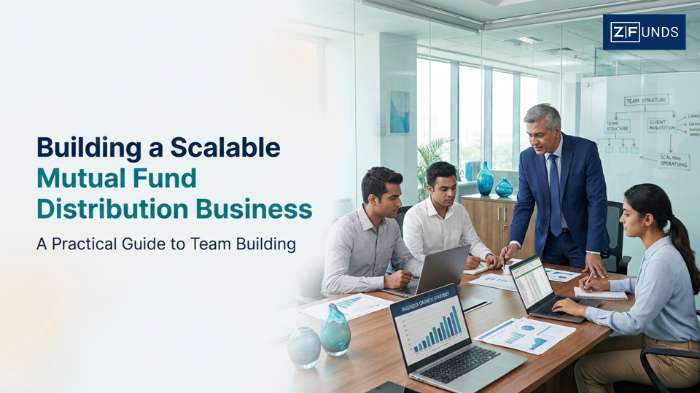
Building a Scalable Mutual Fund Distribution Business: A Practical Guide to Team Building
The Indian mutual fund distribution industry has undergone a major transformation over the last ten years. Increasing investor awareness, regulatory changes, and the increasing adoption of digital technology have opened new doors for mutual fund distributors (MFDs). Nevertheless, with the increasing size of the business for MFDs, there is a major challenge that most MFDs face.
Mutual fund distributors usually start their careers as individual entrepreneurs. In the initial period, they handle all the functions of the business from scratch. This includes acquiring new clients, servicing them, documenting all the operations, executing transactions, etc. Later on, when the number of clients grows sufficiently, the major challenge for MFDs is no longer acquiring new clients, rather it is servicing them efficiently.
In this period, it becomes extremely important for MFDs to build a team. Scaling up a mutual fund distributor business is not merely about increasing the sales efforts or promotional activities for all the schemes. It is rather about building a team that helps the business grow efficiently.
In this article, we will provide a practical framework for mutual fund distributors who want to build and manage an effective team while maintaining service quality and regulatory compliance.
Become a Mutual Fund Distributor at ZERO Cost!
By clicking on button you agree with and

Get Updates on WhatsApp and SMS
Understanding the Need for a Team in Mutual Fund Distribution
The nature of a mutual fund distributor business in a mutual fund requires a number of different activities:
- Lead generation and investor outreach activities
- Conducting conversations and educating investors
- Executing transactions and documentation
- Conducting portfolio reviews and servicing
A distributor can handle all these activities individually at the beginning. However, as the number of clients increases, the activities also tend to multiply. Hence, distributors face a challenge in managing all these activities individually. A good team structure can help distributors manage these activities and create a scalable business model.
Step 1: Hiring with the Right Attitude
One of the most common hiring mistakes in financial distribution is placing too much emphasis on qualifications and not enough on attitude. While technical knowledge is important, the long-term success of a team always depends on behavioural qualities.
Mutual fund distributors should focus on four key attributes when selecting team members.
Willingness to Learn
Financial markets are constantly changing, with a plethora of new mutual fund schemes, regulatory guidelines from SEBI and AMFI, tax laws, and changing investor sentiments, which require a continuous learning curve. So team members should also be open to continuous skill development and industry updates.
Team-Oriented Mindset
In a mutual fund distribution business, several aspects like marketing, advisory discussions, operations, and servicing are involved, where a person who prefers working in solitude may not perform well. A collaborative mindset will always ensure smoother internal processes and better client experiences.
Entrepreneurial Thinking
When a person thinks like a business owner, they are more concerned about the business as a whole, as opposed to their own performance, and hence are more likely to contribute positively for the growth of the business.
Ethics and Investor-First Thinking
The Mutual Fund Distribution industry is heavily regulated. Guidelines from the Securities Exchange Board of India (SEBI) and the Association of Mutual Funds in India (AMFI) place a high emphasis on investor protection and transparency.
The team members must realise that building trust among the investors is key to a successful business. Ethical behaviour and compliance must be core values.
If these traits are present, skills can be built; if these traits are absent, all the skills in the world cannot help candidates help the firm in the long run.
Step 2: Evaluating Education and Industry Experience
Having assessed attitudes and cultural fit, the next factors for a distributor to assess are relevant knowledge and experience.
Financial Literacy
Basic financial literacy in concepts such as risk, return, diversification, compounding, and asset allocation is necessary for most client-facing roles.
Team members must be able to understand and, in turn, communicate how different types of mutual fund investments operate in a given investment portfolio.
Communication Skills
In mutual fund investing, complex financial concepts must be communicated in simple terms. In many cases, clients will look to their distributor for guidance in volatile markets or when making investment decisions.
As a result, strong communication skills are a must, especially for Relationship Managers (RMs).
Relevant Industry Experience
Individuals coming from the banking, insurance, broking, and financial advisory services sectors tend to adjust fast to mutual fund distribution roles due to their familiarity with financial products and client engagement processes.
For entry-level operational positions like tele-calling and back-office assistance, experience in administrative processes and document management is relevant. Knowledge in the financial sector can be provided through training.
Step 3: Building the Team in Phases
Team development should be a phased process that matches the growth of the business. Hiring too fast may result in unnecessary costs and inefficiencies, while waiting too long may result in operational overload.
Phase 1: Distributor with Administrative Support
At the early stages of the business, the distributor is typically responsible for managing the majority of the business functions on their own. The first hire should be an administrative support staff member rather than another relationship manager.
Some of the typical responsibilities may include:
- Managing client documentation/forms
- Scheduling meetings and calendars
- Following up on client reminders
- Maintaining basic records and operational tasks
This allows the distributor to concentrate on the investors, the relationship, and the business development.
Phase 2: Adding Relationship Managers
As the client base grows along with the frequency of interactions with investors, the next step is to onboard Relationship Managers.
RMs are critical to:
- Client relationship management
- Investor meetings
- Portfolio review support
- New investor acquisition support
Before hiring new Relationship Managers, it is important for distributors to define performance benchmarks. Many firms use the following productivity-based criteria:
- Number of active client families managed by each RM
- Assets under management per Relationship Manager
- Number of SIP accounts managed by each RM
These metrics help ensure that team expansion is based on measurable business growth rather than assumptions.
Phase 3: Expanding Operational and Lead Support
As the business grows further, operational complexity increases. Hiring dedicated back-office and tele-calling support can help maintain service quality.
The responsibilities of the business at this stage would typically include:
- KYC and documentation processing
- SIP mandate processing
- Follow-ups for incomplete documentation
- Lead qualification and appointment scheduling
The above structure would enable the Relationship Manager to focus more on client interactions and less on other administrative tasks.
Step 4: Creating a Consistent Lead Generation System
A team can only perform effectively if there is a continuous flow of potential investors. Therefore, successful mutual fund distributors view lead generation as a continuous process rather than a one-time event.
Lead generation strategies can be both online and offline in nature.
Offline Channels
These are traditional lead generation techniques that are still important in financial distribution. Some examples are:
- Investor awareness programs (IAPs)
- Educational seminars/workshops
- Housing society meetings
- Referrals from chartered accountants/tax consultants
- Partnerships with local businesses
These channels are important because they give distributors a level of credibility and direct access to potential investors.
Online Channels
Digital marketing is an important part of lead generation in mutual fund distribution.
Some examples are:
- Search engine marketing/social media advertising
- Educational blogs/financial content creation
- Investor webinars/workshops
- Downloadables/consultation forms
Digital channels allow distributors to reach a wider audience and create scalable marketing pipelines.
Step 5: Implementing Performance Metrics and Review Systems
Many distribution businesses lack a measurement system. However, clear performance metrics are important for maintaining accountability and improving productivity.
A successful and effective team must measure the following metrics:
Client Engagement Metrics
These metrics measure the effectiveness of the team in maintaining its relationship with the investors.
The metrics may include:
- Number of portfolio review meetings conducted monthly
- Percentage of clients contacted quarterly
- Ratio of inactive clients
High engagement metrics imply that the team is actively engaging the clients rather than waiting for the clients to call them.
Revenue Quality Metrics
The revenue metrics must measure the sustainable revenue rather than the revenue earned for the current period.
The important metrics may include:
- Growth in SIP book value
- SIP ratio
- Ratio of systematic investments to lump sum transactions
Consistent SIP value growth indicates a strong relationship between the clients and the team.
Relationship Manager Productivity
The productivity of the RMs must be measured by using the following metrics:
- Number of meetings scheduled and conducted
- Percentage of leads converted to investors
- Assets handled by the RMs
- Number of new SIP accounts created
The metrics enable the distributor to measure the effectiveness and efficiency of the team.
Step 6: Building a Strong Team Culture
Beyond performance numbers, organisational culture plays a significant role in long-term success. A positive organisational culture will promote knowledge sharing, ethical behaviour, and collaborative problem-solving.
Distributors should frequently check if:
- Team members are sharing knowledge and best practices
- Service quality and ethical behaviour are just as important as sales performance
- Error management is open and prompt
Recognition and incentives should be tied to positive behaviour that builds the organisation, including ethical behaviour, teamwork, and shareholder focus.
Conclusion
However, scaling a mutual fund distribution business is not only about stepping up sales efforts or product offerings. True scaling is about building a structured organisation in which people, processes, and culture complement each other well.
A high-performing team is built gradually. First, you add support people to handle the administration. Next, you add relationship managers and operations specialists. Having a clear hiring model, a disciplined lead generation model, and a performance management system helps to ensure scalability.
Above all, a successful mutual fund distributor understands that trust is the only asset of a mutual fund distribution business. A high-performing team is a team that puts its heart and soul into doing the right thing for investors.