


Alternative Investment Funds - A Complete Guide to AIFs
Updated on November 14, 2024

Written by Manish Kothari
CEO Zfunds

Share



Get Investment Advice from India's Top Experts
By clicking on button you agree with and

Get Updates on WhatsApp and SMS
In the world of investing, traditional asset classes like equities, bonds, and real estate have been replaced with Alternate Investment Funds (AIFs). They have reshaped the investment landscape, offering investors access to another range of investment opportunities and strategies. In this article, we'll delve into what AIFs are, different types of AIFs available in the market, their benefits and risks, and the regulatory framework of these investment vehicles.
In the world of investing, traditional asset classes like equities, bonds, and real estate have been replaced with Alternate Investment Funds (AIFs). They have reshaped the investment landscape, offering investors access to another range of investment opportunities and strategies. In this article, we'll delve into what Alternate Investment Funds are, different types of AIFs available in the market, their benefits and risks, and the regulatory framework of these investment vehicles.
What are Alternative Investment Funds (AIFs)?
Alternate Investment Fund (AIF) is a privately pooled investment vehicle which collects funds from investors for the purpose of investing. They are the special investment category that adhere to SEBI Rule and Regulations, 2012. These can be in the form of company, trust or Limited Liability Partnership (LLP), etc.
Generally, big institutions and HNIs invest in AIFs as these funds invest in a wide range of asset classes like equity, real estate, debt, commodities, and even in venture capital or hedge funds. These funds allow for greater flexibility in terms of investment strategies and provide a wide variety of investment options outside of the common asset classes like equity Fund, hedge funds, venture capital, real estate funds, PIPEs, and others. This flexibility can be lucrative for investors who are looking for diversification and higher returns.
As per the latest data available, currently Rs. 1.4 lakh crores of investments have been made by AIFs in India.
Different Types of Alternative Investment Funds (AIFs):
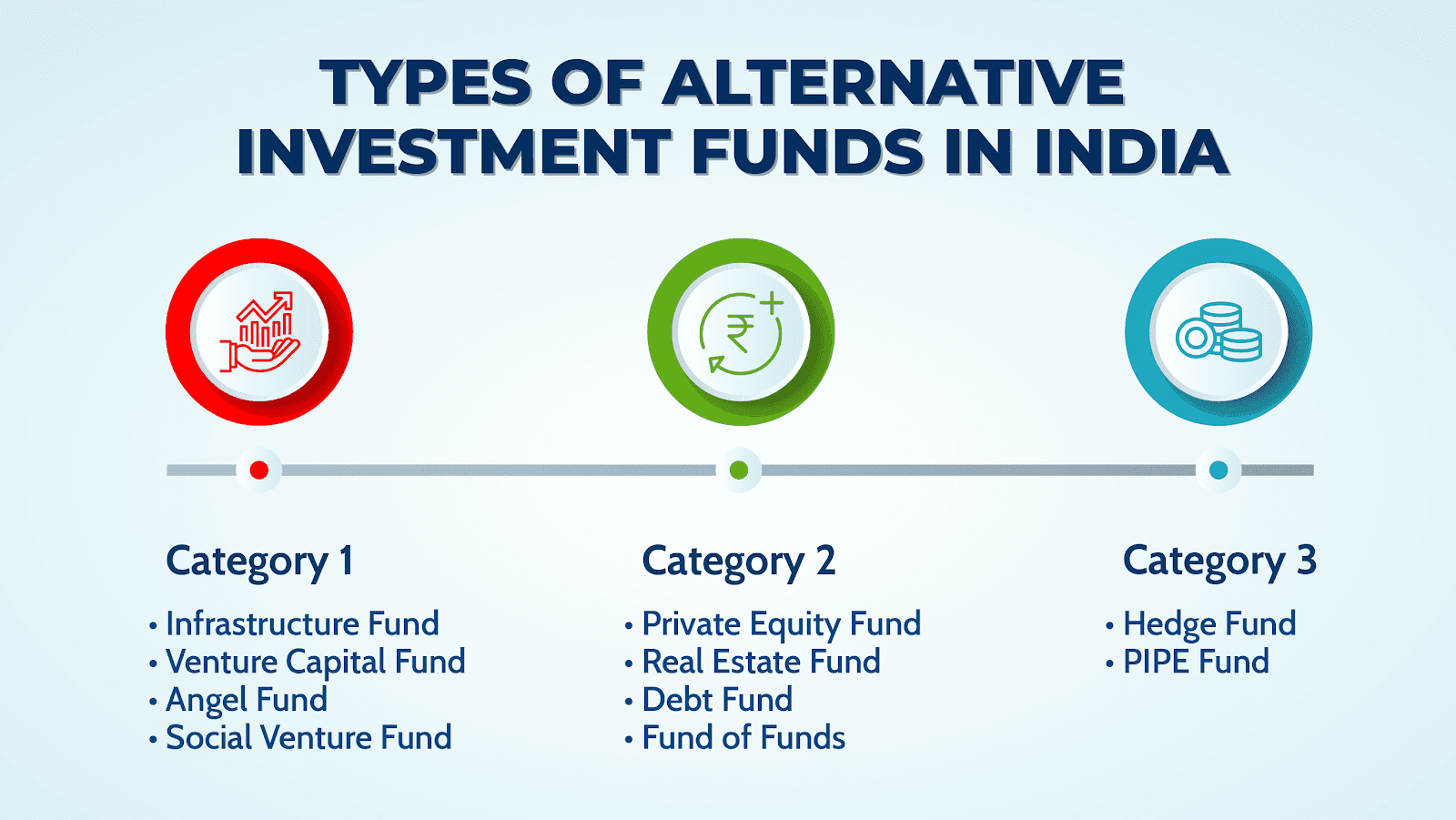
Securities and Exchange Board of India (SEBI) have classified Alternative Investment Funds (AIFs) into three types which are mentioned below:
Category 1 AIFs
Alternative Investment Funds (AIFs) that invest in ventures being in their initial or beginning stage, social ventures, small and medium enterprises also called SMEs, infrastructure, or other sectors that are considered potentially advantageous in social and economic aspects by government or regulators. The funded ventures are expected to generate economic benefits for the country including generating employment, innovative offerings & promoting economic growth.
Category 1 comprises different funds such as:
Infrastructure Fund
Infrastructure funds are those funds that invest in companies that are either directly or indirectly involved in infrastructure development-related projects in the nation. Corporates involved in industries such as power, metals, estate, etc. come under the infrastructure sector.
Venture Capital Fund (VCF)
Venture Capital Funds are those funds that provide funding to start-ups in their initial stage to help them expand their business. The funded start-ups carry a high potential of growth and the investors can expect to earn good returns over time on their share of investments.
Angel Fund
Angel funds are those funds which the investors facilitate by providing funding in exchange for receiving an equity position in the company. The angel fund makes investments in startups or businesses in their early stage and generally requires its investors to have prior experience as an investor, entrepreneur, or senior management professional which will help in guiding the funded start-ups. These funds are a sub-category of the Venture Capital funds in the Category-1 AIF.
These funds are considered a kind of equity funding.
Social Venture Fund (SVF)
Social Venture Funds are those funds in which social venture capitalists or groups facilitate funding in ventures that have the potential to become a social boon as an enterprise. The Social Venture Funds promote investments in ventures or businesses that aim to operate their activities in a socially responsible manner i.e without harming the environment or social values. These funds want to generate returns for their investors by investing in companies incorporating the best practices of corporate governance, protecting the environment & deploying advanced technologies.
Also Read : Nism VA Certification
Category 2
These Alternative Investment Funds (AIFs) do not undertake leverage or borrowings other than to achieve operative objectives on a daily basis and as allowed by regulations set by the SEBI for the AIF Category 2. This category includes different types of funds, such as:
Private Equity (PE) Funds
Private Equity Funds (PE Funds) are those funds that make investments in unlisted companies which can’t use other sources of funding. The investors in these funds are generally called limited partners and are given a share in the invested companies in proportion to their investments. Investments in these funds are directly made into different private companies to diversify investments.
Real Estate Funds
Real Estate Funds are funds that invest in securities issued by corporations or companies that further invest in projects in the real estate sector.
Debt Funds
Debt funds are those funds that invest in debt or debt-related securities issued by the unlisted or listed companies to generate returns as per the investment objective of the AIF. Debt funds are also called fixed-income funds.
Fund of Funds
Fund of Funds is the Alternative Investment Funds that follow the investment strategy of holding a diversified portfolio of other investment funds rather than directly making investments in investment instruments or securities.
Also Read : Nism Mock Test
Category 3
These Alternative Investment Funds (AIFs) are funds that deploy different complex investment strategies to generate returns for the investors. These funds may also use leverage to make investments in listed and unlisted equity or other derivative products. These AIFs include different funds such as:
Hedge Funds
Hedge Funds are those funds that are built as limited liability partnerships. These funds deploy complex investment strategies including using technical analysis, algorithmic trading, derivative trading, etc. to make investment-related decisions. As the name implies "hedge", these funds aim to protect against downside risks through their exposures in related instruments available in the market.
PIPE Funds
Private Investment in Public Equity Funds (PIPE) are those funds that involve private investments made by investment organizations, mutual funds, and other investors into publicly traded equities. These funds invest in equity stocks of corporations or companies at a discounted price of the current value in the market. PIPE funds are of different types such as traditional, structured, etc.
Also Read : Nism Full Form
Key Benefits of Alternative Investment Funds (AIFs)
- It allows investors to diversify their investment to alternative markets like real estate, private equity, commodities, venture capital or hedge funds. By diversifying, we can reduce risk and potentially increase overall portfolio returns.
- These investments target high-growth orientation sectors, like start-ups or infrastructure, that can provide you with high returns compared to traditional asset classes. However, this comes with a higher risk, as they are highly volatile.
- Unlike traditional funds, AIFs offers a wide range of investment strategies, such as leveraging, short-selling, and derivatives, which provide flexibility in achieving the fund’s investment goals.
- AIFs can open doors to asset classes and markets that are not available for investment directly like investors can access private equity, pre-IPO investments, or even real estate projects.
- AIFs may offer favourable tax treatment. For example, they invest in investment options that can give investors minimize tax liabilities.
Investment in Alternative Investment Funds (AIFs)
Investments in AIFs are suitable for high-net-worth investors because of the higher minimum ticket size for investments. The investments can be made by Indian residents, NRIs, and foreign Investors as well.
AIFs other than Angel Funds have criteria of a minimum investment size of Rs.1 crores as per SEBI rules. For angel funds, the minimum investment size is Rs.25 lacs.
Who should invest in Alternative Investment Funds (AIFs)?
Investments in AIFs are somewhat different than the other traditional investments available in the market due to their basic characteristics. Their very high-risk nature coupled with higher minimum investment requirements makes it only suitable for High high-net-worth investors (HNIs). Also, these investments are suitable for sophisticated investors who have an understanding of the markets & similar investments and the risks associated with such investments.
Risks Involved in Alternative Investment Funds (AIFs)
- Lock-in period - Many AIFs have a lock-in period, during which investors cannot withdraw their funds.
- Regulatory Risk - AIFs are less regulated compared to traditional mutual funds or stocks, which can expose investors to more risks. While regulators in countries like India and the UK have put in place frameworks to protect investors, AIFs are still subject to less oversight than mainstream funds.
- High Minimum Investment - AIFs usually require a high investment amount that is why it is best for investors or institutional investors who are looking to invest a high amount of investment.
- Complexity and Lack of Transparency - The investment strategies used by AIFs, particularly those in Category II and III, can be complex and difficult for average investors to understand. Some AIFs also have a lack of transparency, making it challenging for investors to calculate the risks associated with the fund.
- Higher Fees - AIFs have higher management fees and performance fees than traditional investment vehicles. These fees can lower the investor returns.
Regulatory Framework for Alternative Investment Funds (AIFs)
In many countries, including India, AIFs are subject to regulatory frameworks set out by financial regulatory authorities to ensure transparency, fairness, and investor protection. For instance:
- India: The Securities and Exchange Board of India (SEBI) regulates AIFs in India under SEBI (Alternative Investment Funds) Regulations, 2012. These regulations govern the operations, registration, and reporting requirements for AIFs, ensuring that they operate in a structured and compliant manner.
- United States: AIFs are generally regulated under the Securities and Exchange Commission (SEC), with some funds needing to comply with regulations like the Investment Company Act of 1940, while hedge funds and private equity funds fall under more specific rules depending on their structure and investment approach.
Taxation of Alternative Investment Funds (AIFs)
Under the Finance Act 2015, categories 1 and 2 of the Alternative Investment Funds (AIFs) have been granted special pass-through tax status under section 115UB of the Income Tax Act of India, 1961. This means that incomes or gains received by AIFs get taxed in the hands of investors in AIFs in a way that assumes investments have been made directly by the investors and so, the tax would need to be paid by the investors at the slab rates applicable to them.
However, the Category-3 AIF which includes investment in hedge funds, PIPEs, etc. has still not been given pass-through status by the Indian tax law which leads to higher taxes on these investments. The taxes on these investments need to be paid at the fund level and are not passed on to the investors. The effective taxation rate for AIF Category-3 comes out to be around 42.7% including the highest tax slab rate of 30%, a surcharge of 37.5% on the tax, and applicable cess rates.
Read More: Aditya Birla Investment Plans: A Comprehensive Guide
Conclusion
Alternate Investment Funds is one of the attractive and popular investment options for investors who are looking to diversify their investment beyond traditional assets and pursue potentially higher returns. However, they come with their own set of risks that investors must look at carefully. Understanding the different types of AIFs, their investment strategies, and the regulatory environment is essential. It can be a powerful tool in an investor's portfolio, they can diversify their investment through it. AIFs provide a wide range of opportunities to dynamic global markets.
Frequently Asked Questions (FAQs) - Alternative Investment Funds
Q. Are AIFs open-ended?
A. AIFs under Category 3 do have a choice to be open-ended in nature.
Q. What is the corpus of the AIF?
A. 'Corpus' is the complete amount of funds committed by investors to the AIFs through a written contract or any document.
Q. Can AIF launch schemes?
A. Yes, AIF can launch schemes under certain terms.
Q. How many categories do AIF have?
A. AIFs have been classified into three sub-categories.
Q. Is a Real estate fund an AIF?
A. Yes, Real estate funds come under category 2 in AIF.
More Information:
Bharat Bond ETF
Shariah Compliant Mutual Funds
What is Expense Ratio in Mutual Funds
Best Large Cap Mutual Funds to Invest in India
Best Small Cap Mutual Funds to Invest in India
What is Rupee Cost Averaging in SIP ?
Steps to Become Mutual Fund Advisor